Radiofrequency tightening
Thermage in Myeongdong, Seoul
Not a cheaper or pricier version of HIFU. Radiofrequency heats the dermis in bulk rather than at points, which makes it the answer to a different complaint.
- KRW 2,189,000600 shots, VAT included
- 30–90 minin the chair
- Redness hoursask about makeup after treatment
Quick answer
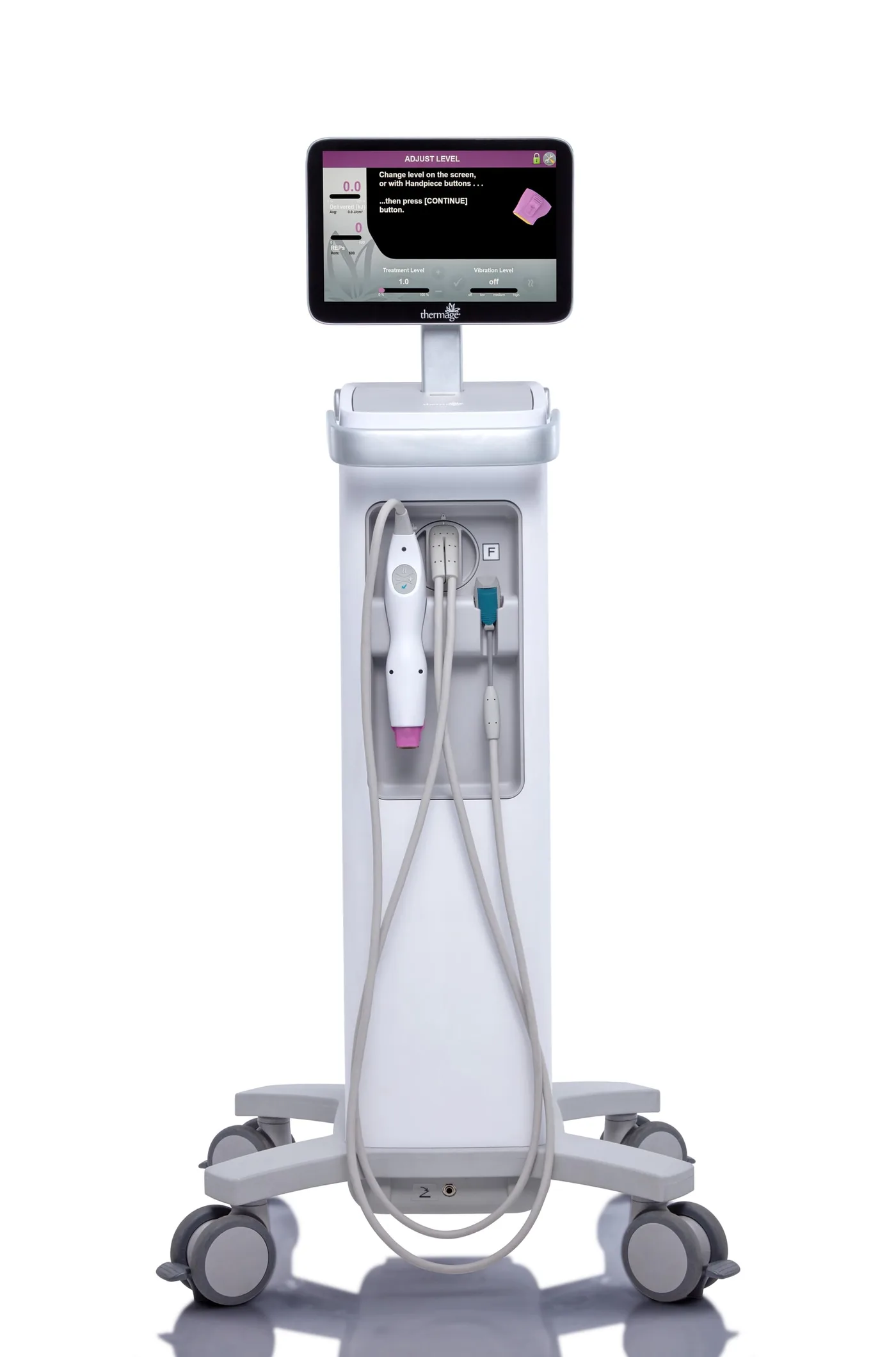
Thermage at Kind Global Clinic Myeongdong is monopolar radiofrequency on hardware by Solta Medical, passing energy through a cooled skin surface to heat the dermis and deep dermal collagen in bulk. A 600-shot full-face treatment costs KRW 2,189,000 including 10% VAT, takes 30–90 minutes, and a separate 225-shot eye-area treatment is available.
Mechanism
Heat spread wide, not focused deep
The cooled tip is the whole trick: it lets the surface stay comfortable while the layer beneath it gets hot enough to matter.
Monopolar radiofrequency works by passing current through tissue, which resists it and heats up as a result. Because the current spreads rather than converging on a point, the heating is volumetric: a broad region of dermis warms together instead of discrete columns being cooked at a set depth — the fundamental difference from focused ultrasound, and the reason the two treatments do not substitute for one another.
The surface is protected by active cooling at the tip. Hodgkinson DJ describes the mechanism plainly in Clinics in Plastic Surgery: radiofrequency passed through a cooled epidermis produces thermal change in the dermis and the deep dermal collagen. The remodeling of that collagen is what leads to clinically discernible improvement in sagging skin and skin quality. Cooling is not a comfort feature bolted on; without it the energy needed at depth would injure the surface.
Because the effect is diffuse, Thermage answers diffuse complaints. Overall looseness across the cheeks, crepey texture, a general lack of tension in the skin — those respond to volumetric heating better than to focused points. A single lost jawline edge is the opposite case, and focused ultrasound reaches it more directly. Clinics that describe RF and HIFU as competing tiers of the same thing are simplifying to make a sale.
Shot count is the dose. Six hundred shots is a full-face treatment at Kind Global Clinic Myeongdong; the 225-shot eye-area treatment uses a different tip designed for the thinner skin around the eye, where a full-face tip would be both uncomfortable and imprecise. The tip is single-use and its shot count is metered, which is why the price does not scale smoothly and why a partial treatment is not meaningfully cheaper.
Suitability
Who it suits, and who should not have it
The right-hand column matters more than the left. A physician confirms both in person before anything starts.
Likely a good fit
- Diffuse laxity and loss of skin tension across the cheeks and lower face, rather than one sagging edge
- Crepey texture and fine surface looseness alongside laxity — RF tends to improve both together
- Someone who has had focused ultrasound and found it addressed the jawline but not overall tightness
- Skin around the eyes and upper eyelid area, using the dedicated eye tip
- Anyone who would rather have one substantive session than a course spread across several appointments
- People with thicker, heavier skin, where volumetric heating tends to be the better-matched mechanism
Not suitable, or needs review first
- Pregnancy or breastfeeding — treatment is deferred
- An implanted cardiac pacemaker or defibrillator, or any implanted electronic device: monopolar current is an absolute contraindication here
- Metal implants within the treatment field, including certain dental hardware
- Volume loss rather than laxity — radiofrequency does not replace lost fat, and can in rare cases reduce it
- Active infection, open lesions or inflammatory acne in the treatment area
- Severe laxity beyond what a non-surgical treatment can reach; a surgical opinion
- Isotretinoin within the last six months, keloid tendency, or active autoimmune connective tissue disease, each without review first
On the day
How long you are actually there
Each step carries its duration so a visit can be planned around a flight rather than the other way round.
-
01
Assessment and grid marking
15–20 minutes
A physician assesses skin thickness and laxity pattern. A treatment grid is marked on the skin so that passes are counted and distributed evenly rather than estimated.
-
02
Return pad and preparation
5–10 minutes
The operator places a return electrode, because monopolar current needs a path out. This is also where implants and devices are confirmed one final time.
-
03
Topical anesthetic, where used
20–30 minutes
We use numbing for lower tolerance or for the eye area. Many people have the full-face treatment without it, since cooling handles much of the sensation.
-
04
Delivery, grid square by grid square
30–60 minutes
Each pulse is a cold-then-hot-then-cold cycle. The heat spikes briefly and is meant to be felt: the operator uses your feedback to stay at an effective level without crossing into injury.
-
05
Cooling and soothing
10 minutes
Cooling in the powder room. Redness is usual and generally settles within a few hours.
-
06
Aftercare briefing
5–10 minutes
Written aftercare and the expected timeline, including why the result is judged at three months rather than three days.
Allow about 85 to 140 minutes for the steps above, for a 600-shot full-face treatment. Reception, first-visit paperwork and payment sit outside them. Discuss your travel dates and follow-up needs before choosing an appointment.
Recovery
What happens over the following weeks
Individual response varies. What follows is the usual pattern, not a promise about yours.
| Phase | What you may notice | Do | Avoid |
|---|---|---|---|
| Day 0 | Redness and a flushed, warm feeling. Occasional mild swelling. Most of it settles within hours. | Moisturize, sun protection, plenty of water. | Sauna, jjimjilbang (Korean bathhouse), alcohol, strenuous exercise, hot showers. |
| Day 1–3 | Residual warmth and occasional tenderness. Visible redness is usually gone. Makeup is generally fine from the next day. | Normal skincare and normal activity. | Aggressive exfoliation, high heat, deep massage on the treated area. |
| Week 1–2 | Some people notice a modest early tightening that then fades. This is normal and not the final result. | Continue normal routine. Take a photograph in the same lighting as your reference. | Reading the early fade as failure. |
| Month 2–3 | Collagen remodeling completes and the result is at its clearest, particularly for skin quality and texture. | Compare photographs with the clinic and decide whether to repeat. | Expecting the defined edge that focused ultrasound produces — that is a different mechanism. |
Uncommon problems include blistering, prolonged swelling, a burn where cooling failed or the return path was compromised, and — rarely — a visible depression from loss of subcutaneous fat in the treated area. Any of those warrants contacting the clinic rather than waiting to see.
Prices
List, standard and first-visit prices in one table
Three prices exist for many items, so all three are shown together. The final column is what you hand over.
Radiofrequency lifting
| Treatment | List price (KRW) | Standard price (KRW) | First-visit price (KRW) | You pay, VAT included |
|---|---|---|---|---|
| Thermage600 shots | 2,388,000 | 1,990,000 | — | KRW 2,189,000≈ $1,638 |
| Thermage225 shots · eye area | 1,188,000 | 990,000 | — | KRW 1,089,000≈ $815 |
The 7 other items in the radiofrequency lifting group are priced in the full price list.
The last column is what you hand over — the applicable price plus 10% VAT, which Korean clinics exclude by convention. Korean and foreign patients pay the same. US figures convert at KRW 1,336.2 to $1 (September 9, 2026).
The price page carries every treatment, how the three price columns work, and what changed with the tourist VAT refund in 2026.
Comparison
Thermage against the ultrasound options, and against the other RF platforms
Kind Global Clinic runs three radiofrequency platforms as well as two ultrasound ones. The price differences within RF are as large as the difference between the categories.
| Dimension | Thermage | Oligio X | Density Alpha | Ultherapy Prime |
|---|---|---|---|---|
| Energy | Monopolar RF | Monopolar RF | RF | Microfocused ultrasound |
| Manufacturer | Solta Medical | Wontech | Jeisys Medical | Merz Aesthetics |
| Heating pattern | Volumetric, whole dermis | Volumetric | Volumetric | Focused points at fixed depths |
| Best answer for | Diffuse laxity plus skin quality | The same, at a lower price point | The same, mid-range | A lost jawline or jowl edge |
| Full-face shot count priced | 600 shots | 300 or 600 shots | 300 or 600 shots | 300 or 600 shots |
| Dedicated eye treatment | Yes, 225 shots | Yes, 200 shots | No | Yes, 200 shots |
| Pacemaker or implanted device | Absolute contraindication | Absolute contraindication | Absolute contraindication | Active implants are contraindicated; discuss all implants with the physician |
Oligio X and Density are on the full pricing page and answer a similar complaint for less money. Thermage is the longest-established platform of the three, with a deep body of published literature behind it, which is what the premium reflects — not a different mechanism.
Physicians
Who decides the plan, and who performs it
The physician sets the energy level, the depth and the treatment area at consultation, after examining your skin.
Dr. Lee Won Jin, Dr. Lee Kang In and Dr. Oh Se Won — the physicians of Kind Global Clinic Myeongdong — assess the treatment area in person and set the plan before anything begins. All three are licensed physicians practicing at a dermatology clinic, and the two representative directors have held senior elected office in the Korean Public Health Doctors Association.
If you want to know who will be holding the handpiece for your session, ask when you get in touch and you will get a straight answer in writing before you travel.
Evidence
What the literature actually says
Every citation below was checked against CrossRef and PubMed on August 17, 2026, and each carries its own limitation.
-
Hodgkinson DJ. Clinical applications of radiofrequency: nonsurgical skin tightening (thermage). Clinics in Plastic Surgery. 2009;36(2):261–268.
Describes the mechanism directly: radiofrequency passed through a cooled epidermis produces thermal change in the dermis and deep dermal collagen, and remodeling of that collagen leads to clinically discernible improvement in sagging skin and skin quality.
Limitation A clinical-applications review rather than a randomized comparison.
These are small studies. None of them is a large randomized trial, and none of them was run at Kind Global Clinic Myeongdong. They are here so you can read the primary sources and judge them yourself. They also show the size of the evidence base, which for aesthetic devices generally is thinner than marketing implies.
Questions
Questions people ask about this treatment
Answered with numbers and intervals rather than a referral to consultation.
How much does Thermage cost in Seoul?
Thermage at Kind Global Clinic Myeongdong costs KRW 1,990,000 excluding VAT for a 600-shot full-face treatment, which is KRW 2,189,000 including 10% VAT, against a list price of KRW 2,388,000. The dedicated 225-shot eye-area treatment is priced separately in the table on this page. Korean and foreign patients pay the same amounts. Two other radiofrequency platforms at the same clinic answer a similar complaint for considerably less, and they appear on the full pricing page.
Can I have Thermage with a pacemaker?
No — an implanted pacemaker or defibrillator is an absolute contraindication to Thermage and to every monopolar radiofrequency treatment. Monopolar current travels through the body to a return electrode, and that path can interfere with an implanted electronic device. This is not a cautious-practice matter that can be worked around with lower settings. Tell the clinic before you travel. Do not assume focused ultrasound is suitable instead: its device-specific contraindications also need to be checked by the physician.
How long does Thermage last?
The clinic does not publish a repeat interval for Thermage, and this page does not invent one. The result is at its clearest about two to three months after the session, and then declines gradually rather than stopping. Some early tightening in the first two weeks is common and then partially fades, which regularly gets misread as the treatment failing. How long it holds depends far more on your age, baseline skin quality, sun exposure and smoking than on the shot count.
Does Thermage hurt?
Thermage is felt as a repeating cold-hot-cold pulse, and the heat spike is meant to be noticeable — the operator is calibrating to your feedback to stay at an effective level without causing injury. Many people have the full-face treatment without topical anesthetic because the tip’s cooling handles much of it, and numbing is used for the eye area or for lower tolerance. If a pulse is genuinely painful rather than sharply warm, say so immediately: that is information the operator needs, not something to endure.
Should I choose Thermage or Oligio X?
Oligio X answers a similar complaint to Thermage using the same monopolar radiofrequency mechanism, at a substantially lower price, and for many people it is the one to try first — the prices for both are on the full pricing page. Thermage is the longest-established platform in the category, with a deep body of published clinical literature, which is what its premium buys rather than a different mechanism. If cost is a real constraint, starting with Oligio X and reassessing at three months is a defensible plan.
Can Thermage make my face look thinner or hollow?
Loss of subcutaneous fat leading to a hollowed appearance is a recognized though uncommon complication of monopolar radiofrequency, and it is the reason energy settings and treatment mapping are a physician’s decision rather than a maximum-power setting. It is more of a risk in thin faces with little fat to begin with. If your concern is volume loss rather than laxity, radiofrequency is the wrong treatment and a good clinic will tell you that at consultation.
How soon can I fly after Thermage?
The timing of your flight after Thermage should be agreed with the treating physician before you book. Share your arrival and departure dates, and leave time for any follow-up the clinic recommends. Visible redness or swelling is only part of recovery; feeling well enough to travel does not rule out a later complication. Avoid scheduling treatment on your departure day, and confirm how to obtain care if a concern develops after you return home.
Is Thermage worth the price compared with Korean RF platforms?
Whether Thermage is worth its premium over the Korean radiofrequency platforms depends on how much weight you put on the published literature behind the longest-established platform in the category. The mechanism is the same, and Oligio X and Density at the same clinic cost considerably less for a comparable full-face treatment. A reasonable approach is to start with the lower-cost platform, assess the response at three months, and reserve the premium option for the case where it did not deliver.
Can I combine Thermage with focused ultrasound in one visit?
Combining Thermage with focused ultrasound in a single visit is exactly what the clinic’s larger packages do, and it makes sense because the two mechanisms address different things — bulk dermal heating and focused energy at depth. The combined sitting runs to roughly 60 to 120 minutes. Whether it is right for you is a physician’s judgment: stacking two heat-based treatments raises the chance of swelling and, in the wrong face, of fat loss.